Considering SRS?
For many transgender women, the decision to pursue Sex Reassignment Surgery (SRS) is deeply personal and transformative. But one of the most searched topics — and rightly so — is understanding SRS results, both in terms of appearance and function. In this article, we’ll explore what to expect from SRS before and after from a medical, aesthetic, and healing perspective.
Aesthetic SRS Results: What You Will See
The goal of SRS is to create external genitalia that closely resemble those of cisgender women. High-quality SRS results are judged on the following:
- Realistic Labial Structure: Formation of labia majora and minora with a symmetrical and natural look
- Clitoral Construction: Designed from sensitive tissue to appear authentic and retain sexual sensitivity
- Natural Vaginal Introitus: A proportionate and feminine-looking vaginal opening

According to peer-reviewed data, over 90% of patients report high satisfaction with the aesthetic results of their SRS.
(Source: Journal of Sexual Medicine)
Functional SRS Results: How Your Body May Respond
Beyond looks, SRS results are also evaluated by function. Here’s what to expect:
- Urination: Ability to urinate sitting down without discomfort or deviation
- Sexual Sensation: Most patients retain the ability to achieve orgasm post-surgery
- Depth and Lubrication: Techniques such as peritoneal or intestinal vaginoplasty may offer enhanced depth and self-lubrication
Research indicates that a majority of post-op patients experience significant improvement in both sexual function and gender congruence.
(Source: The Journal of Sexual Medicine)
How SRS Results Differ by Technique
The technique you choose shapes your functional result far more than your aesthetic one. External appearance — labia majora and minora, clitoral construction, vaginal introitus — is built to the same standard across methods. What differs is the canal.
| Depth | Self-lubricating | Ongoing discharge | Daily maintenance | |
|---|---|---|---|---|
| Colon vaginoplasty | Greatest potential | Yes | Highest | Irrigation 2–3× weekly; lubricant advised |
| PPV (peritoneal) | Good | Yes | Lighter than colon | Irrigation 2–3× weekly; lubricant advised |
| Skin graft | Set at surgery | No | Minimal | Lubricant required for penetration |
On depth. Depth is not fixed on the operating table. It is maintained — and can be improved — by consistent dilation. Colon vaginoplasty patients who dilate well often progress from around 7 inches to 7.5 inches or more, because colonic tissue is elastic and responds to sustained dilation. Skin graft and PPV tissue is less elastic, so depth stays closer to what was created surgically.
On lubrication. Colon and PPV are self-lubricating, because the transplanted tissue keeps producing its own moisture. Skin graft does not, and requires lubricant for penetrative activity. The trade-off is discharge: self-lubricating techniques produce ongoing mucus, heaviest with colon vaginoplasty. We cover that honestly in our guide to colon vaginoplasty discharge and odor.
On sensation. This does not vary by technique. In every method, the nerve endings from the glans are preserved in the construction of the neoclitoris, so sensation and orgasm capability are comparable across all three. Most patients regain both by four to six months.
Which technique suits you depends on your anatomy, how much depth matters to you, and how much daily maintenance you are willing to take on. Our PPV vs colon vaginoplasty comparison goes through the decision in more detail.
SRS Before and After: What to Know About Healing and Scars
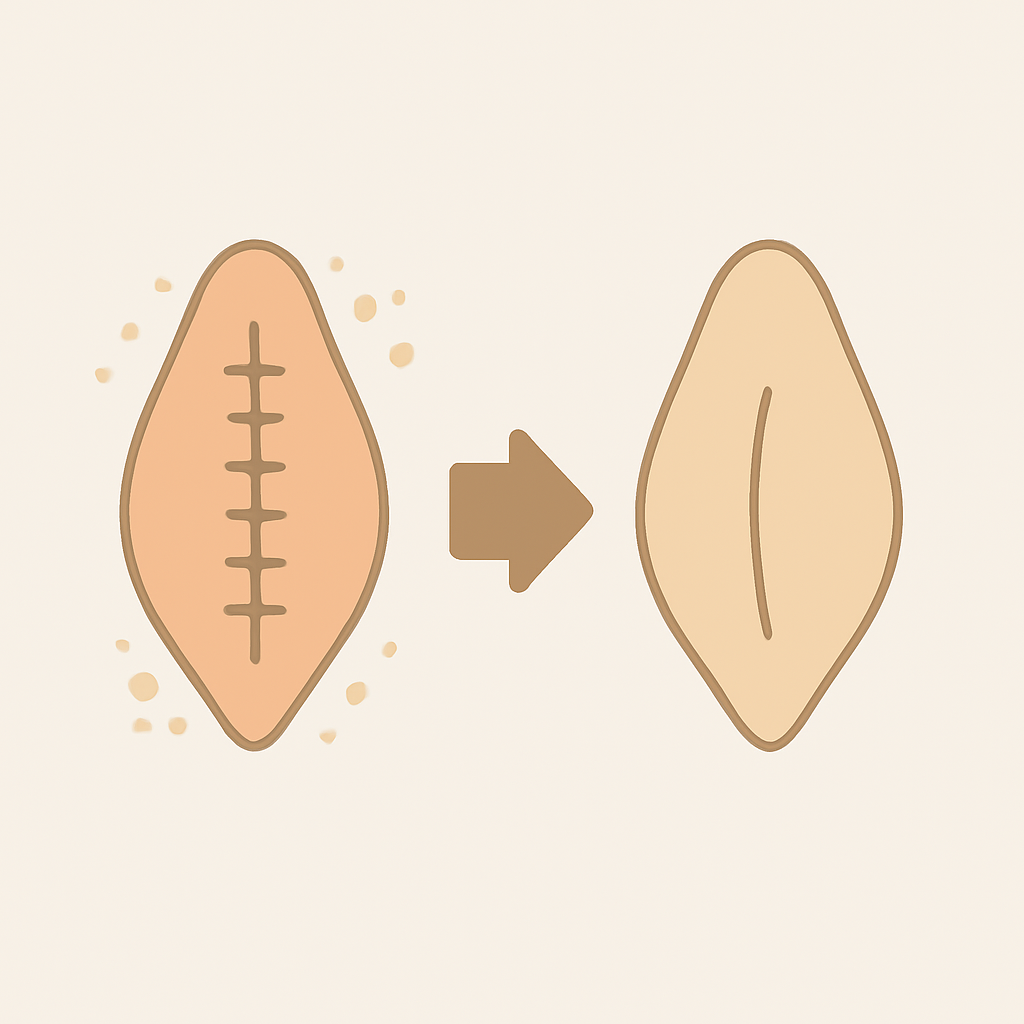
One of the most frequently searched topics online is “SRS before and after” — and it’s completely understandable. People considering SRS results are naturally curious about how the body heals, what the outcomes look like over time, and how different surgical techniques compare aesthetically.
Healing takes time, and what you see in the first months is not your final result. Swelling distorts everything early on, scars begin red and fade toward flesh tone, and the whole process takes roughly a year to settle.
We have covered that process in full — week by week, from packing removal at day five through to the twelve-month mark — in our SRS healing timeline. This page is about the destination. That one is about the journey.
Due to the sensitive nature of this procedure, we present only general visual references in our public materials.
Note: If you are looking for more detailed SRS before and after images featuring actual surgical results — including all major techniques we offer — you are welcome to reach out to the APS Gender Care support team via the contact form on our website. Upon request, our coordination team can provide access to our rich and secure database of surgical outcomes during your online consultation with our leading surgical team.
This allows us to share meaningful, personalized examples that match your body type, expectations, and transition goals — all in a private and respectful setting.

How to Set Realistic Expectations for SRS Results
Everyone heals and adapts differently. It’s important to understand that:
- SRS results may vary based on anatomy, health status, and surgical technique
- Some patients may undergo refinements or revisions for optimal results
- Full healing can take 6–12 months
- Emotional and psychological outcomes are just as important — many report reduced gender dysphoria and improved self-image
What Do Good SRS Results Look Like?
Successful SRS results mean more than just physical changes — they represent affirmation, alignment, and confidence. While each journey is unique, modern surgical techniques and post-op care offer excellent outcomes for most patients.
If you’re looking for individualized guidance or wish to learn more beyond “SRS before and after” visuals, we’re here to help.
Results also change considerably over the first year, and what you see at three weeks is not what you keep. If you are recently post-op and unsure whether what you’re seeing is normal, our SRS healing timeline sets out what happens week by week.

If you’re considering a gender-affirming surgery, your next step is simple: Fill out the contact form to connect with our trained staff. We’ll guide you through a personalized consultation with our leading surgeon and help plan every aspect of your journey.
At APS Gender Care, we specialize in all three techniques—skin graft, PPV, and colon vaginoplasty—helping patients achieve results that align with their needs. Our expert team is ready to guide you through every step, ensuring a safe and fulfilling experience. Reach out to us today to see how can we support your transition journey.